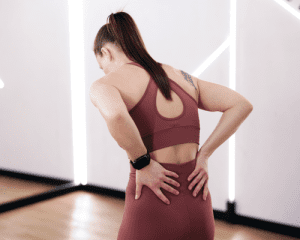
Lifting injuries are a common cause of back pain. You can protect yourself against damage with good lifting habits, both at home and in the workplace.
How Lifting Can Injure Your Spine
When you lift heavy objects, your spine takes on significant stress. Twisting, jerking, or bending forward while lifting can strain the small joints in your spine and put the discs which separate your vertebrae at risk. These spinal discs have a soft, jelly-like core surrounded by a strong fibrous ring, supported by ligaments that hold your vertebrae together. Repeated unsafe lifting can tear these rings or ligaments, leading to a disc bulge or herniation, a common cause of back pain.
Factors that increase spinal stress include the weight of the load, how far it is held from your body, how often and quickly you lift, and how long you hold it. Poor lifting techniques can also contribute to long-term injuries.
If you’re experiencing back pain or recovering from a sports injury, our experienced physiotherapists in Rhodes can help. At Body Focus Physio Clinic, we specialise in physiotherapy in Rhodes, including sports physiotherapy in Rhodes and injury rehabilitation. We also provide care for nearby areas like Putney and Meadowbank, ensuring personalised treatment for every patient.
To protect your spine from injury, always attempt to take the following steps:
- Get a firm footing with your feet apart for a stable base.
- Bend your hips and knees instead of bending at the waist. This allows the leg muscles to take the load and not the spine.
- Tighten your abdominal muscles. Abdominal muscles support the spine when lifting.
- Ensure that you have a strong grip and that the load is as close to you as possible.
- The closer it is to your spine the less force it exerts on your back.
- Brace yourself for the lift but continue to breathe normally through the lift.
- Lift steadily and do not jerk the load. Look straight ahead, not down.
- Keep your back straight and avoid twisting or bending to the side.
- To lower the object, place your feet as you did to lift, tighten stomach muscles and bend your hips and knees.